
Lake Charles Directory Collections
The historical shelf is a set of separate runs, not one complete database. The Southwest Louisiana Genealogical & Historical Library identifies a Lake Charles city directory for 1895-1896. Outside finding aids document later editions on microfilm, while federal census research points to a smaller cluster used around the 1930 enumeration. Each source has its own access rules and gaps.
| Collection | Years represented | Where held | How to reach it |
|---|---|---|---|
| Lake Charles city directory | 1895-1896 | Southwest Louisiana Genealogical & Historical Library | Physical collection; an online PDF link needs verification |
| Lake Charles directory microfilm | Scattered editions, 1911-1960 | Library and microfilm networks | Consult the reel list, then request the exact edition |
| NARA directory reference set | 1927-1931 and 1934 | National Archives reference holdings | Use the editions with 1930 census research |
| 1913 Worley's transcription | 1913 | Genealogy Trails transcription | Online lead only; verify against the original or microfilm |
| Companion local collections | Varies by record | Calcasieu Library and McNeese Archives | Database, staff request, or archive visit |
The microfilm inventory is precise about missing editions. Reels include 1911-1913, 1915, 1917, 1921, 1925, 1927-1931, 1934, 1936-1939, 1941-1943, 1945-1950, and 1952-1960, but not every year within that span. Some editions also cover Westlake, Maplewood, Sulphur, and Hollywood. Record the publication year and locality printed on the title page before treating an entry as Lake Charles evidence.
See the National Archives directory list and the Louisiana microfilm holdings before ordering a reel. Both are finding aids, so the page image remains the key source.
Lake Charles Genealogy Library
The Southwest Louisiana Genealogical & Historical Library at 411 Pujo Street is the best first stop for a local city directory search. Its holdings extend beyond printed directories to newspaper obituaries, selected marriage and birth indexes, cemetery and church records, courthouse documents, land records, military material, family and parish histories, yearbooks, the Maude Reid Scrapbook Index, and the History of Mossville.
Published hours are Monday through Friday, 9:00 a.m. to 6:00 p.m., but confirm them before traveling. Staff can be reached at 337-721-7110 or genstaff@calcasieulibrary.org. Ask for one surname, edition, approximate date, and street when possible. A focused request is far more likely to produce a usable page citation than a request for every person with a common surname.
The library obituary form accepts surname, first and middle name, and death date; advanced fields add birth date and cause of death. A result is a newspaper lead, not a death certificate. Request the newspaper title, date, and page so the clue can be checked later.
Note: Some Lake Charles history tools require a library card, an in-library computer, or help from genealogy staff.
Decode a Lake Charles Entry
A directory entry must be read by the rules printed in that edition. The inspected 1913 transcription clearly lists institutions, streets, and named officials, including schools, churches, clergy, and cemeteries. It does not reproduce a full publisher key for household symbols. Do not assume that spouse, ownership, or widow marks used in another city's directory mean the same thing here.
| Name or institution | The indexed person, business, school, church, or cemetery as printed |
|---|---|
| Street detail | A house number, street, corner, or descriptive location when the edition supplies one |
| Named role | A principal, clergy member, official, or other person tied to an institution |
| Edition and page | The details needed to distinguish the entry from a later volume or transcription |
| Source form | Original scan, microfilm image, database result, or secondary transcription |
Photograph the title page and abbreviation key with the entry. That small habit protects against a common mistake: reading a short form as a fact when the publisher gave it a special meaning. The original page also shows column order and neighboring entries that may be lost in a typed transcript.
- Criss-cross directory
- A section arranged by street and house number rather than by surname. No complete separate Lake Charles run was confirmed in public catalogs, so ask library staff about a specific edition.
- Householder index
- An address-oriented list of household names. Its fields depend on the publisher and year.
- Abbreviation key
- The publisher's legend for shortened words and symbols. Read it before interpreting an entry.
- Transcription
- A typed copy made from another source. It is useful for discovery but should be checked against the original image.
Lake Charles Directory Gaps
Missing years are one of the defining facts of Lake Charles city directories. The reel catalog lists no 1914, 1916, 1918-1920, 1922-1924, 1932-1933, 1940, 1944, or 1951 editions in its respective sequences. A skipped year may mean the publication was not issued, was not filmed, or is absent from that holding. The finding aid alone cannot settle which explanation applies.
When a target year is absent, bracket it with the closest earlier and later editions. Compare the surname, street spelling, and house number in both. Then use a newspaper, census, deed, obituary, or map dated near the gap. This method separates a true move from a missed edition and helps catch changes in street numbers or ward descriptions.
Trace Lake Charles Family History
City directories fill the years between federal census releases. The current public census extends through 1950 under the National Archives 72-year rule. A directory can place a surname at an address near a census year, while the census can show a household that the short directory entry does not.
- Start with the earliest Lake Charles edition likely to contain the person. Save the title page, entry page, and abbreviation key.
- Move forward one available edition at a time. Note every spelling, street, house number, and named institution.
- Pair the closest edition with the 1900 through 1950 federal census. Compare locality, street, household names, and enumeration date.
- For a street view, ask whether that edition includes an address-order section. For modern address records, use the Lake Charles directory by street.
- Close the trail with a cited obituary, cemetery or church record, deed, or archive collection rather than assuming why the listing ended.
A disappearance has several possible causes. The person may have moved, died, changed name, joined another household, or simply fallen outside that publisher's canvass. Independent sources are essential. The library's HeritageQuest access supports census research, while Ancestry Library Edition and HistoryGeo are listed for in-library use.
Map Lake Charles Directory Streets
A name and house number say little about the building itself. The 1909 Lake Charles Sanborn collection contains 39 sheets showing blocks, building footprints, uses, streets, and fire-protection details. It can show what stood near a directory address at the map date, but it is not proof that a named person occupied the site.
For directory-to-census work, the National Archives directory reference page identifies the Lake Charles editions available around the 1930 count.
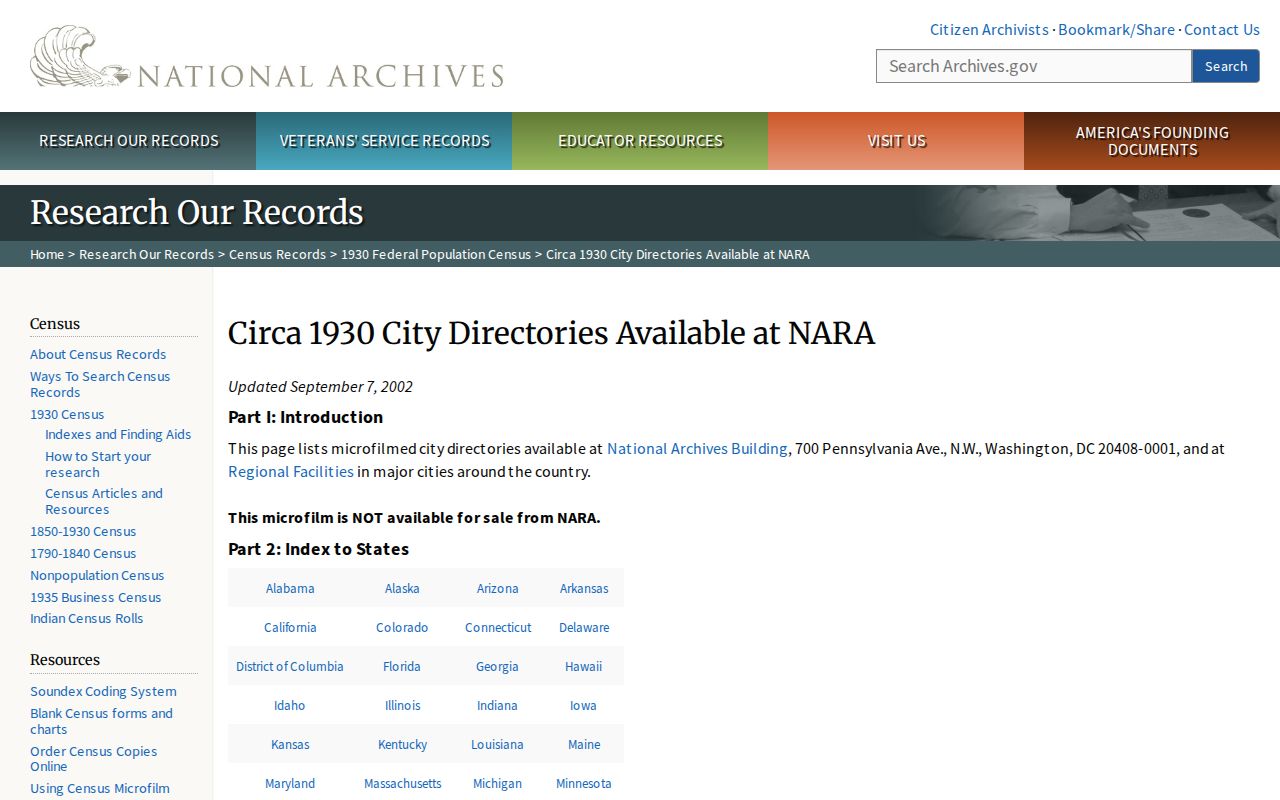
The captured reference helps choose the right edition before a census comparison. Use the cited directory and map year together. If the street name or number does not align, compare another directory year, current GIS street lines, the Clerk's legal description, and City or Parish records. No complete official Lake Charles renumbering chronology was found, so a mismatch should remain unresolved until a dated source explains it.
Lake Charles Archive Network
The Calcasieu Library resource list provides several routes around a missing directory. HeritageQuest covers census and family-history material. Ancestry Library Edition, NewspaperArchive, and HistoryGeo are available in the library; Fold3 adds military records, photos, and yearbooks; HeritageHub adds obituaries; and the Louisiana Digital Library supplies digitized regional material. Access conditions vary.
McNeese's Lether E. Frazar Library Archives holds more than 300 collections and about 5,500 linear feet tied to Lake Charles and Southwest Louisiana. Its papers, photos, maps, business files, school material, and early city records can identify people missed by a printed directory. Contact the archives at 337-475-5731 or archivesdept@mcneese.edu and ask for a collection or date range.
The captured McNeese archives page below shows the official route into those collections.
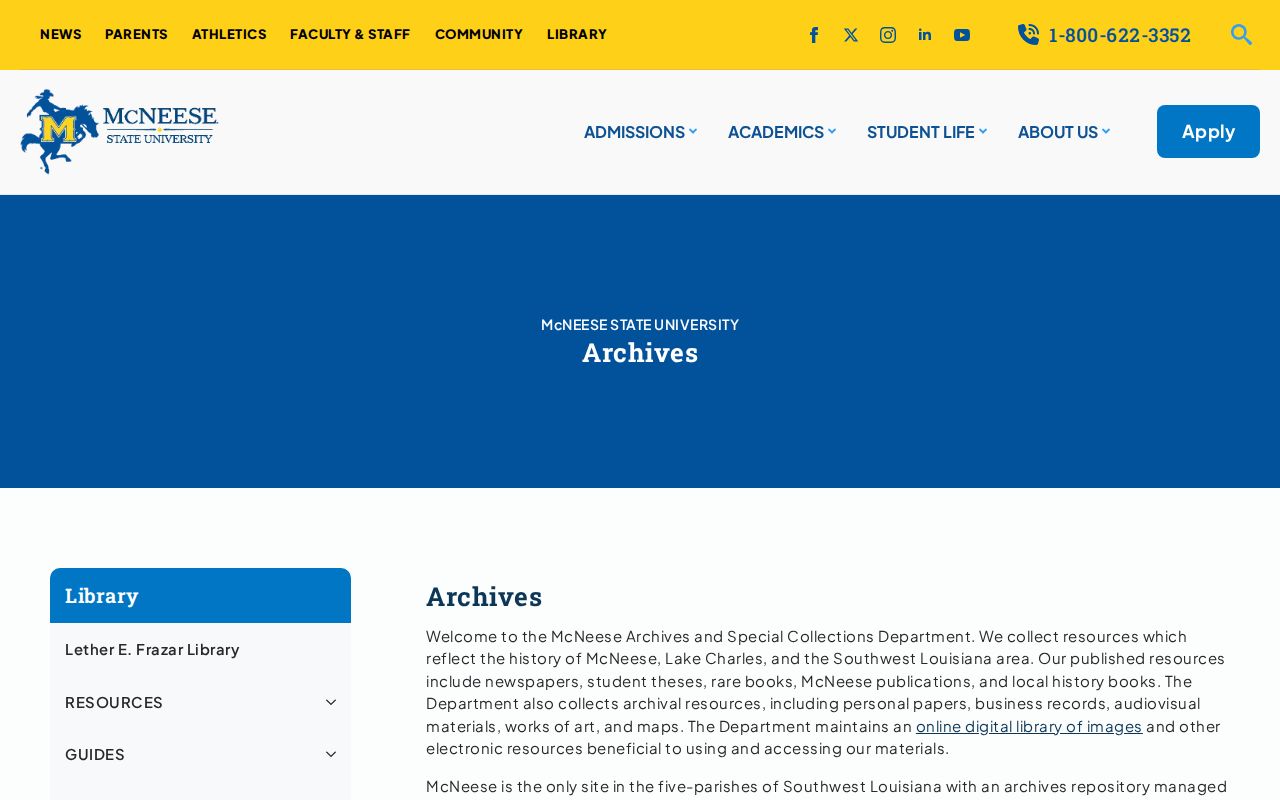
Archive staff can confirm whether a collection is processed, open, and available for copying. Save the collection title, box or folder, item date, and image citation with any name found there.
Pre-Fire Lake Charles Records
The 1910 courthouse fire complicates early Lake Charles research because surviving copies and abstracts are scattered. A major 2026 development may help. McNeese announced the Loftin-Levingston Title Records, which include pre-Fire courthouse material, title abstracts and photocopies dating into the 1840s, maps, and cemetery records across the five-parish Imperial Calcasieu region.
Public access was planned for fall 2026, with a contextual website expected in 2028. That schedule is not proof that a searchable portal is live. Ask the archives for current processing status before making a trip or citing a record.
| 1895-1896 | Earliest local directory holding identified by the Genealogy Library |
|---|---|
| 1909 | Lake Charles Sanborn map supplies block and building context |
| 1910 | Fire-era break requires Clerk, library, newspaper, map, and archive cross-checks |
| 1911-1960 | Scattered city directory editions survive in the documented microfilm runs |
| 2026 | McNeese announced the newly acquired pre-Fire title and courthouse archive |
For an early surname, check the Calcasieu Clerk's archive and Available Dates, the Genealogy Library, LSU newspapers, the Sanborn sheets, State Archives, and McNeese. Request a named series, year, ward, parcel, or family. Broad searches for all early residents are too vague for most archive staff to answer well.
Cite Lake Charles Directory Finds
A historical claim is only as strong as its citation. Record the directory title, edition year, page, locality, publisher when shown, and whether the source was an original scan, microfilm image, or transcription. For newspapers, keep title, date, and page. For McNeese material, save the collection and box or folder. For maps, include the sheet and map year.
If a web link fails, use the fallback chain. Call or email the Genealogy Library, request a reel or page through a library, visit McNeese Archives, or contact the Louisiana State Archives research library. A staff scan request should name one person, edition, and likely page range. This keeps the request narrow and creates a source another researcher can find again.
One directory entry can establish a strong lead. It should still be compared with an independent census, obituary, deed, church record, or archive item before it becomes a firm conclusion about a Lake Charles household.